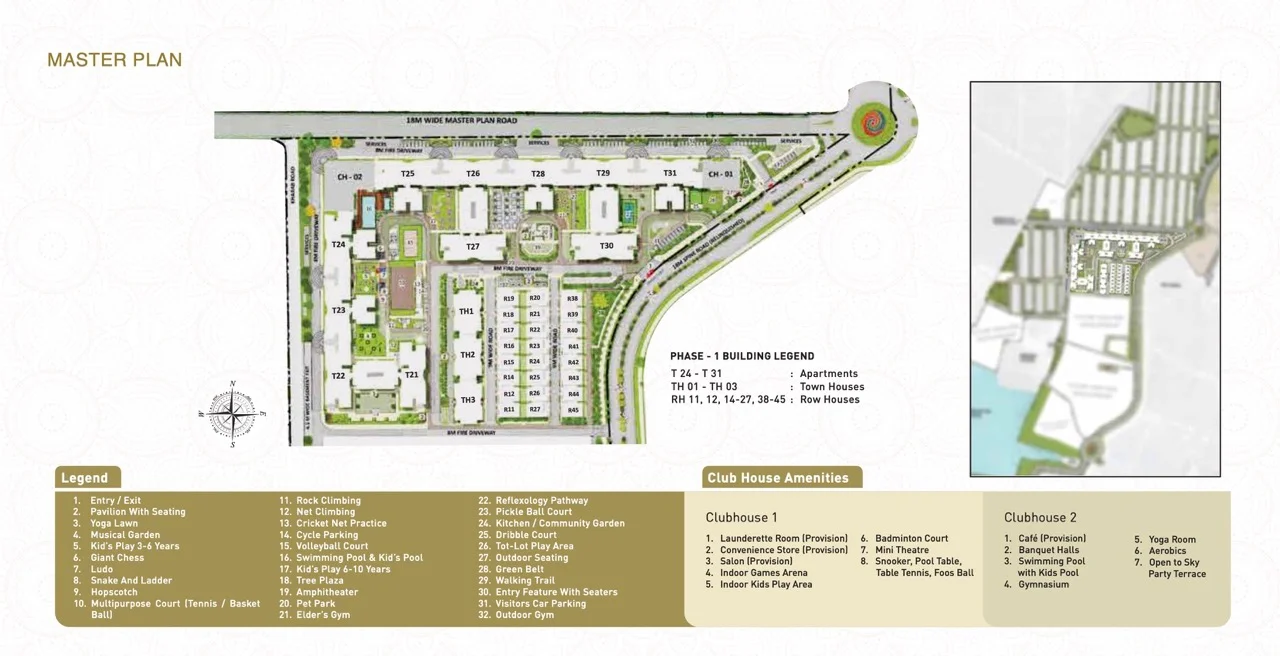
A master plan is a promise made on paper.
It tells you how a developer thinks about space. Whether they're optimizing for unit count or for livability. Whether open areas are genuine or just the leftover land between buildings. Whether the project was designed from the outside in - starting with the boundary wall and filling inward - or from the inside out, starting with how people actually move and live.
Tata Varnam's master plan tells you something clear: this project was designed with restraint.
The Numbers That Matter
Phase 1 sits on 61 acres. It holds 631 units - 583 apartments, 24 townhouses, 24 row houses. Do the math and you get roughly 10 units per acre.
The North Bangalore industry average for comparable projects runs between 20 and 30 units per acre. Tata Varnam is operating at roughly half that density. The remaining land goes to roads, landscaping, amenity zones, setbacks, and open green areas.
This is not accidental. It's a deliberate product decision, and it shapes everything about the master plan - how far apart the towers stand, how wide the internal roads are, how much sky you see from your window.
The Layout: Three Product Zones
The master plan organizes the project into three distinct zones based on product type, and they're layered thoughtfully.
The apartment towers - T24 through T31 - form the primary vertical zone. Eight towers, 10 to 12 floors each, positioned to maximize cross-ventilation and minimize one tower directly overlooking another. With only 6 units per floor, each tower has a narrow footprint relative to its height. This creates gaps between buildings - gaps that let light and air move through the project rather than getting trapped.
The townhouse blocks - TH1, TH2, TH3 - sit at G+3. They occupy a transitional zone between the apartment towers and the row houses. Ground-floor townhouse units have private lawns. Upper-floor units have private terraces. The low-rise scale of these blocks creates a human-proportioned middle ground in a project that also has 12-floor towers.
The row houses - R11 through R45 - are at the perimeter edges, G+2 structures. This placement is smart. Row houses benefit from being closer to the boundary - they get more privacy, more quiet, and a stronger sense of being a standalone home. Putting them at the interior of a dense project would undermine their character. Here, they get the space they need.
The Amenity Spine
Good master plans don't scatter amenities randomly. They create a zone - a spine or a core - where residents naturally congregate.
In Tata Varnam, the amenity cluster sits centrally within the township, accessible from all three product zones without requiring residents to walk along roads shared with vehicles. The clubhouse, swimming pool, gymnasium, sports courts, and children's play areas are organized as a connected precinct rather than isolated facilities.
The master plan layout on the official Tata Housing page shows how the amenity zone relates to the towers - it's reachable from any apartment in under five minutes on foot. That's the practical test of a well-placed amenity block.
Green Cover and Open Space
The landscaping plan includes a walking trail, yoga lawn, musical garden, community garden, and multiple open greens. These aren't token gestures. On a low-density 61-acre site, there's actual land available for them.
The walking trail deserves specific mention. A properly designed internal walking circuit - one that lets you do a meaningful lap without retracing steps or crossing vehicle roads - is a genuine daily-use amenity. It's more valuable than a rock climbing wall or a giant chess board, both of which are listed in the amenities but used occasionally at best.
For families with elderly members especially, a safe, flat, shaded walking path inside the community is something they will use every single day.
The Carnatica Context
Tata Varnam Phase 1 doesn't sit in isolation. It's part of the larger 135-acre Tata Carnatica township, which includes commercial zones, plotted developments like Tata Swaram and Tata Raagam, and future retail and hospitality components.
The master plan for Varnam Phase 1 was designed with this larger context in mind. The internal road network connects to the township-wide circulation plan. Amenities within Varnam will eventually be supplemented by commercial and retail facilities in the broader Carnatica precinct.
This matters for long-term livability. A standalone gated community, however well-designed, eventually hits the limits of what it can offer within its own walls. A township grows with you.
What the Master Plan Tells a Buyer
When you study the Tata Varnam master plan carefully, a few things become apparent.
The developer chose quality over quantity. They could have built more units. They didn't. The open spaces are genuine, not leftover. The product zones are separated sensibly. The amenity placement is functional, not decorative.
A master plan drawn with this kind of thought doesn't happen by accident. It reflects a developer who intends for people to actually enjoy living there - not just buy there.
That's a distinction worth paying attention to.
Tata Varnam Phase 1 is RERA approved. Verify project details on the Karnataka RERA portal using RERA IDs: PRM/KA/RERA/1250/303/PR/110825/007988, /007989, /007990.